
SleepReset
Designing a Better
Sleep Experience
A product design case study on improving user engagement, creating meaningful bedtime support and helping people build healthier sleep habits.
Product Strategy
UX Research
App Concept
SleepReset
Product Strategy
UX Research
App Concept
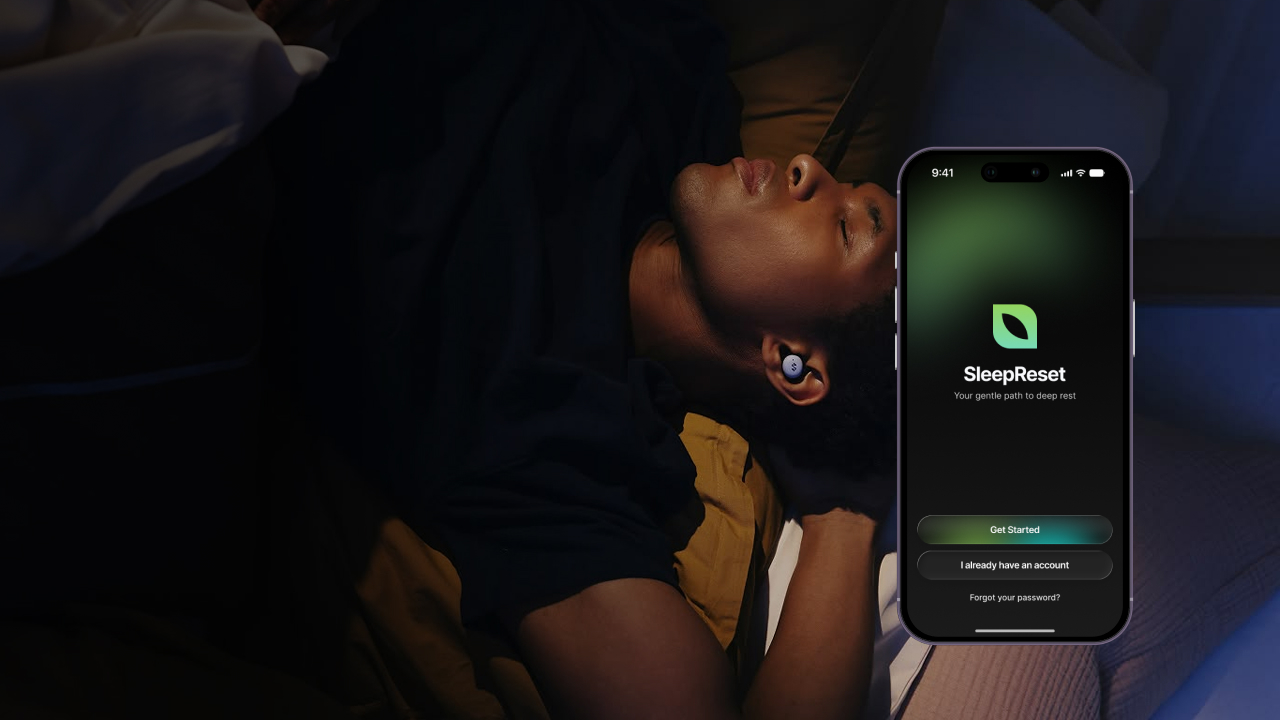
SleepReset is a mobile behavior-change product for people who want to sleep earlier but repeatedly fail to follow rigid bedtime plans.
Instead of only reporting sleep outcomes, the product helps users change the behaviors that happen before sleep: caffeine timing, screen use, unfinished tasks, inconsistent routines, and unrealistic bedtime expectations.

Product
Android, iOS
My role
Design Lead
UX Researcher
Timeline
Q2 2023 - Q2 2024
Product
Product design, Interactive prototyping, User research & testing
Summary
SleepReset focuses on the evening behavior that happens before sleep.
Many sleep products focus on what happened after a user went to bed: duration, interruptions, sleep stages, and scores. These insights may be informative, but they do not necessarily help someone stop scrolling, finish work earlier, or begin winding down consistently.
The user chooses a desired bedtime, builds a short wind-down sequence, and receives a realistic nightly plan. Rather than requiring an immediate jump from the current bedtime to the desired bedtime, SleepReset gradually moves the routine earlier in small steps.
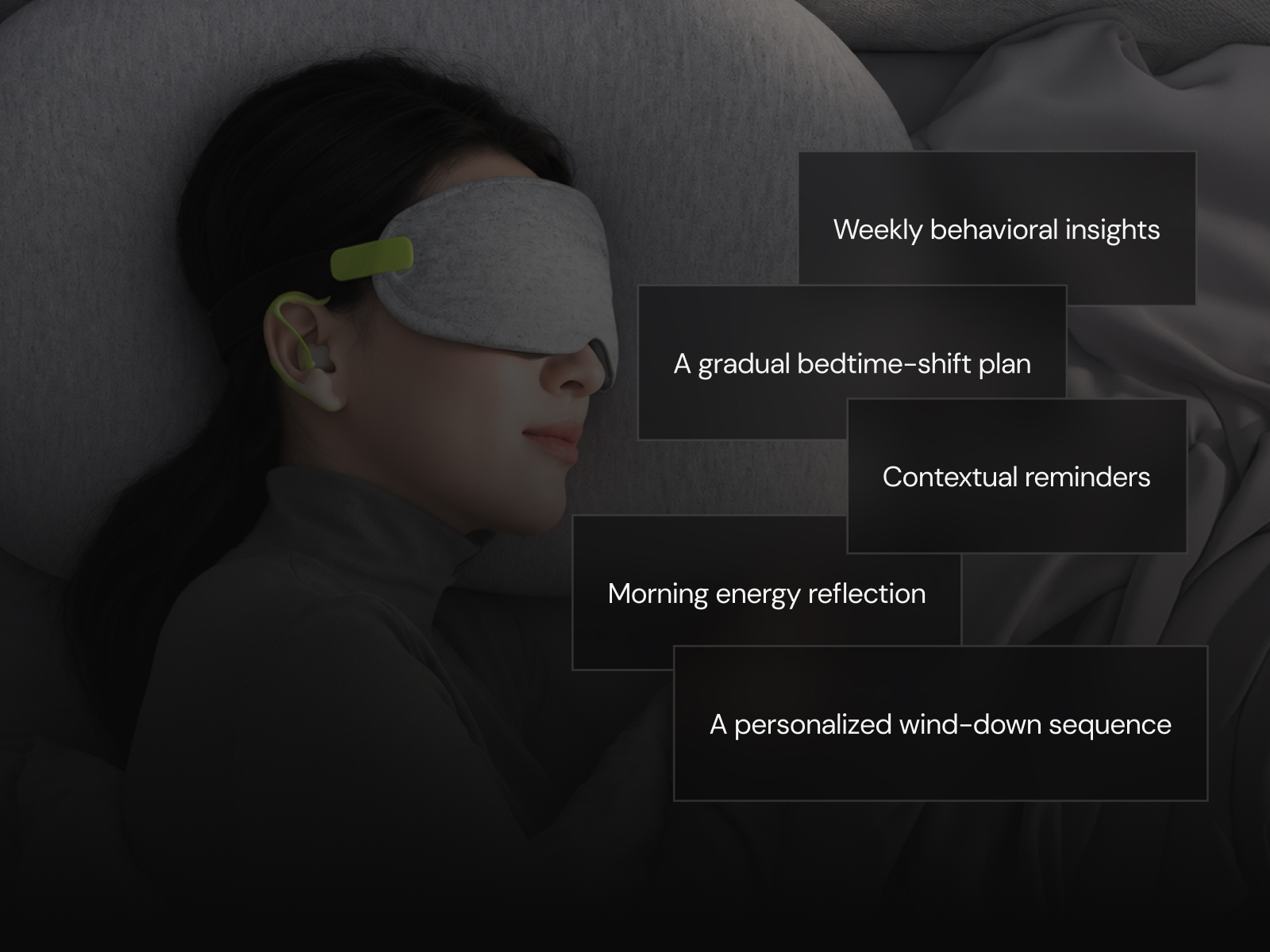
The main UX strategy is:
Reduce the size of the behavior change until completing the routine feels easier than avoiding it.
Project Background
People commonly know that a regular sleep schedule, a calmer pre-sleep period, reduced evening screen exposure, and thoughtful caffeine timing may support healthier sleep habits.
Public health guidance also recommends consistent sleep and wake times, relaxing bedtime routines, limiting electronic devices before sleep, and avoiding caffeine later in the day. [1]

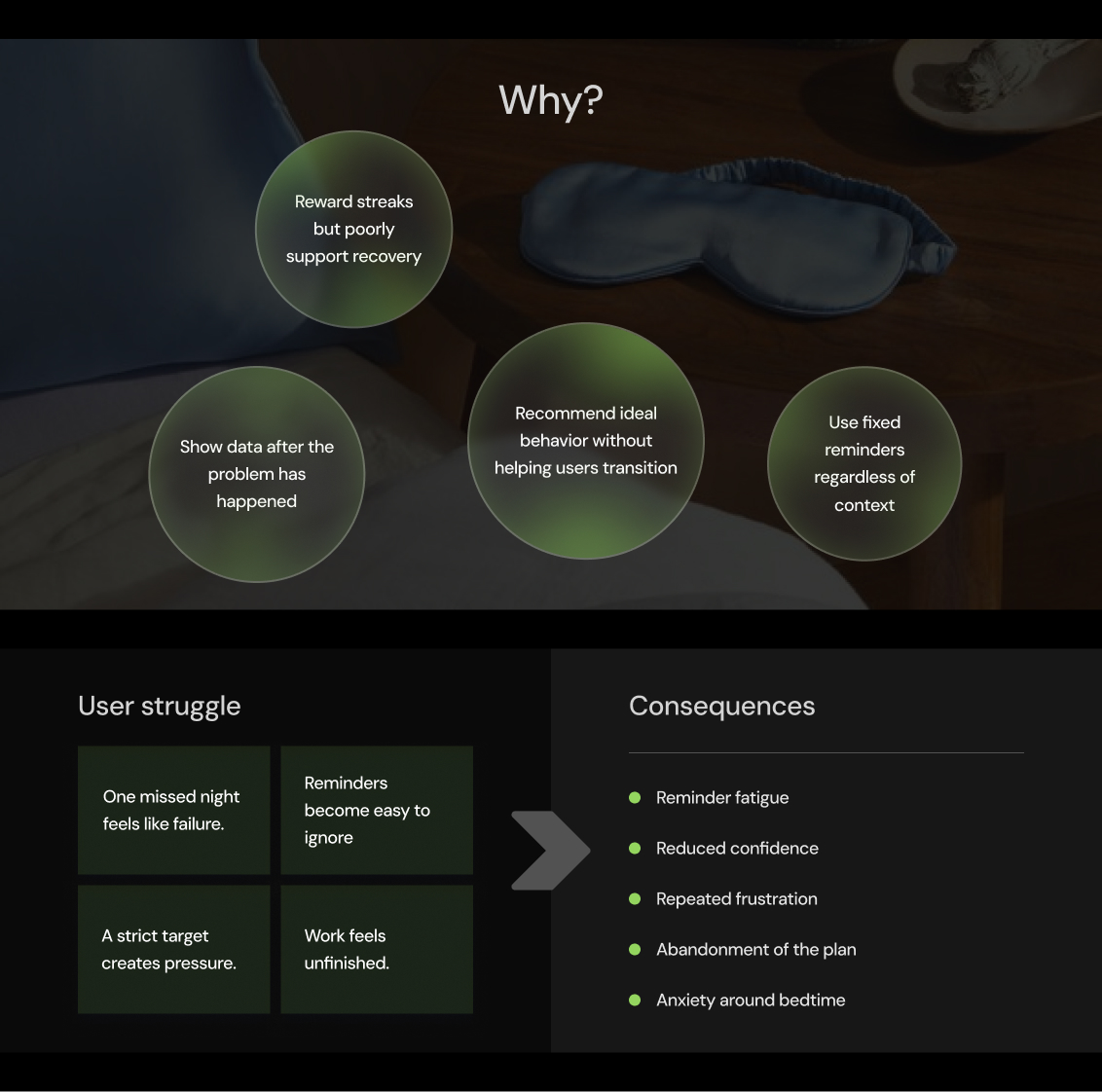
“I still have
work to finish.”

“It is already late, so tonight no longer matters.”

“I missed yesterday, so the plan has failed.”
This creates a gap between sleep knowledge and evening action.
Habit research suggests that small, repeatable actions connected to stable contextual cues can gradually require less conscious effort. Repetition in a consistent context is more useful for habit formation than depending entirely on motivation each night.
Constraints
Research
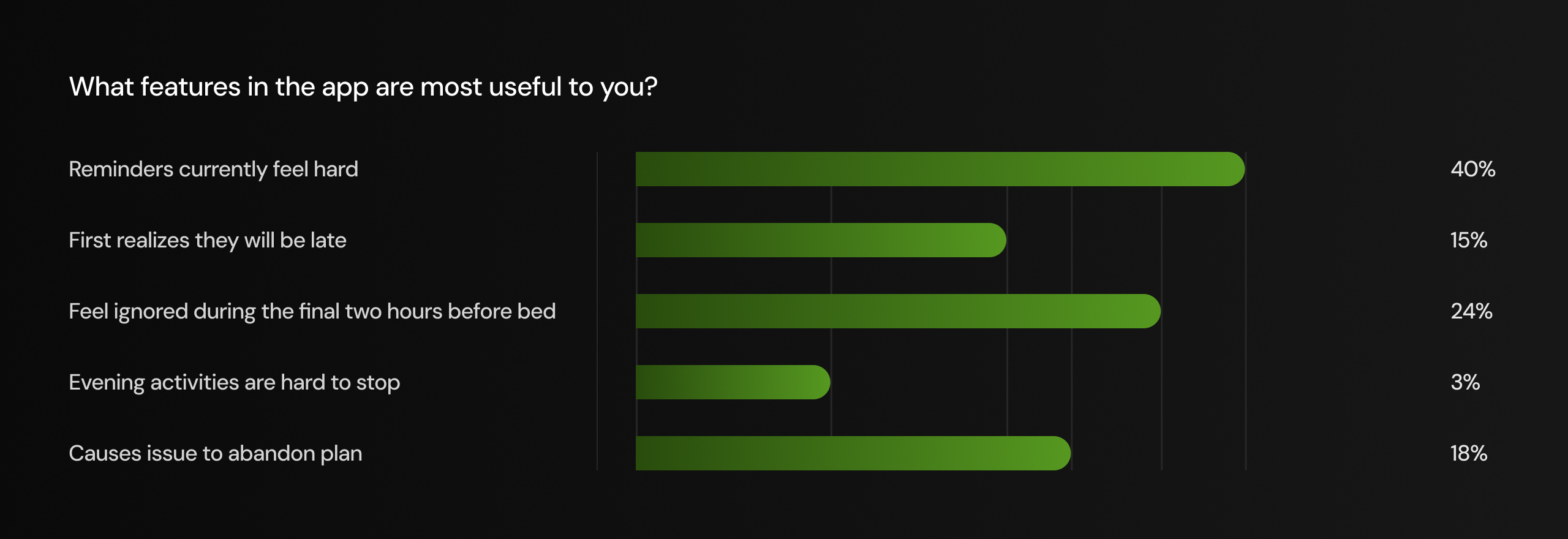
A. Semi-structured interviews
Participants:
10–12 adults who want an earlier bedtime but struggle to maintain it.
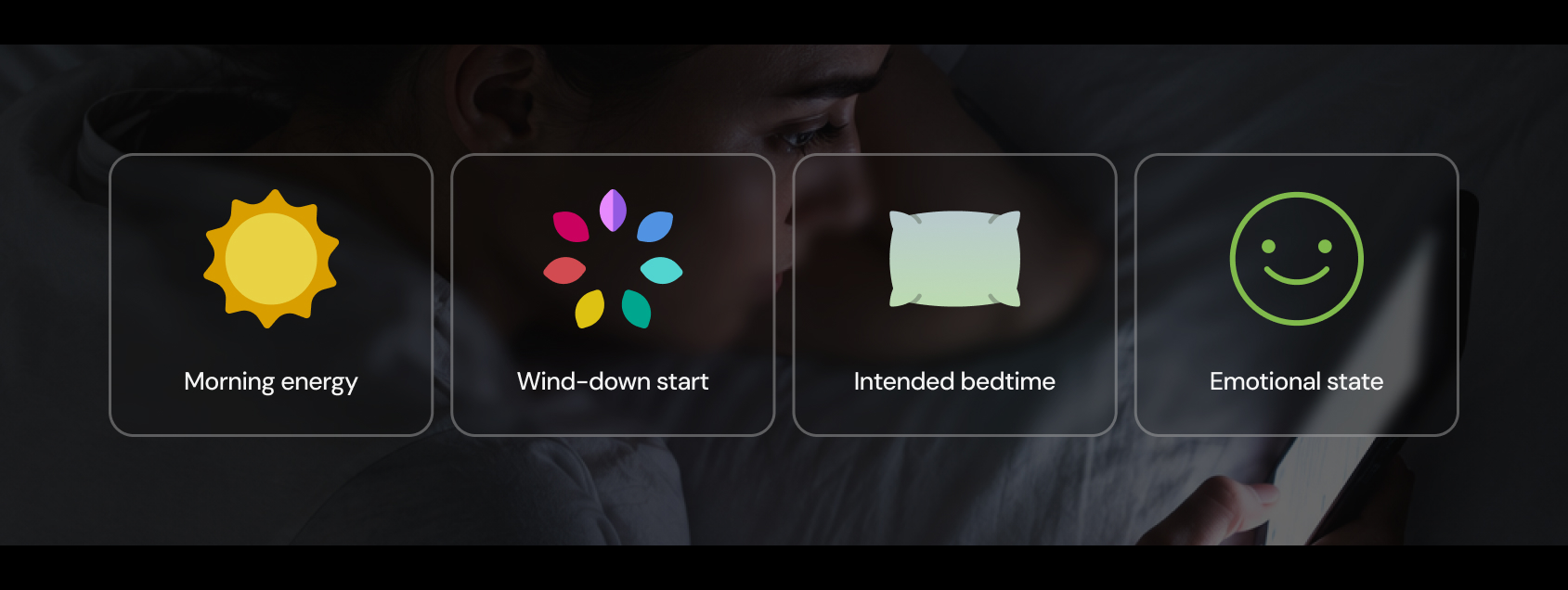
B. Seven-day study
Participant's record:
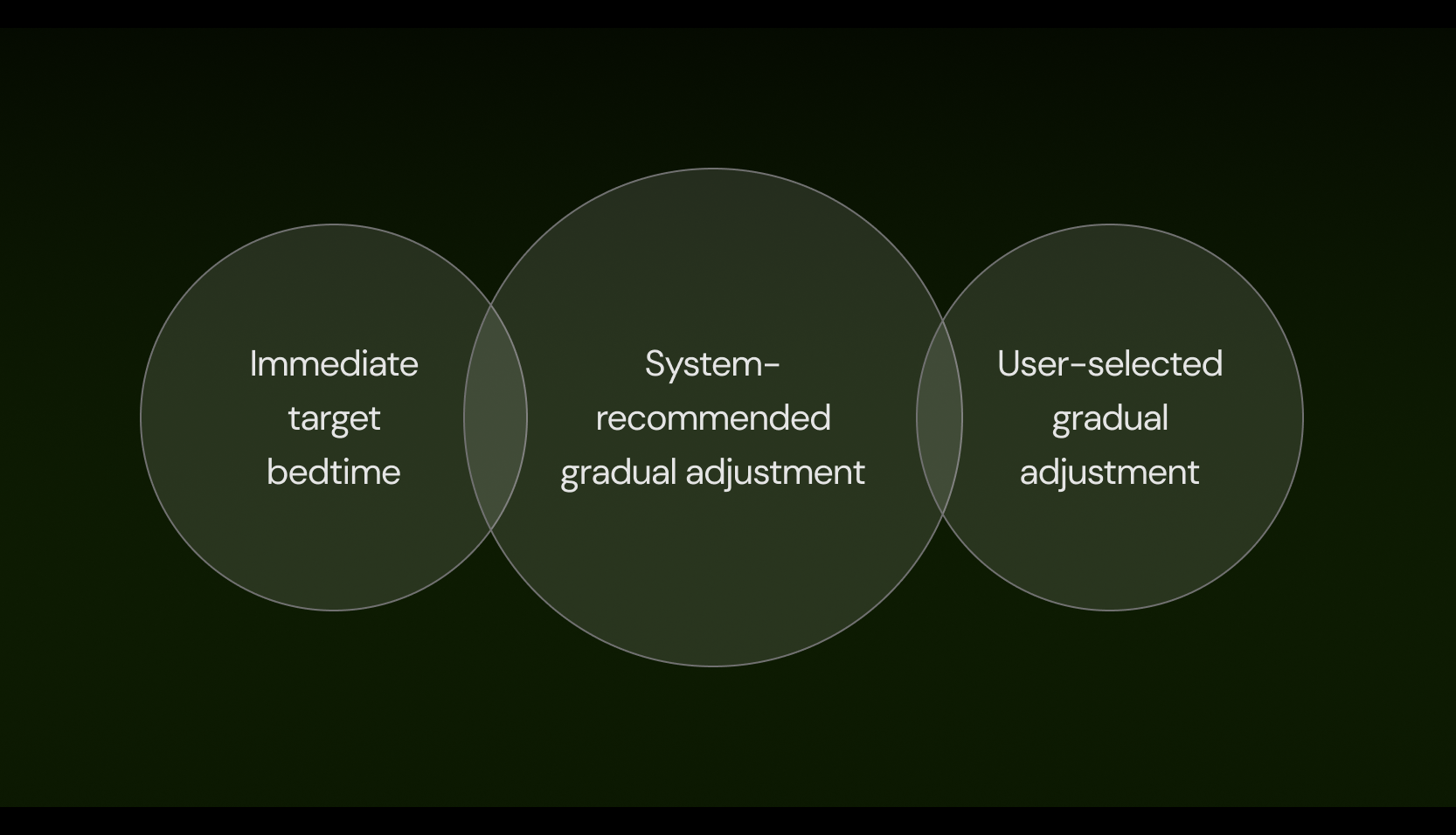
C. Concept testing
Compare three models:
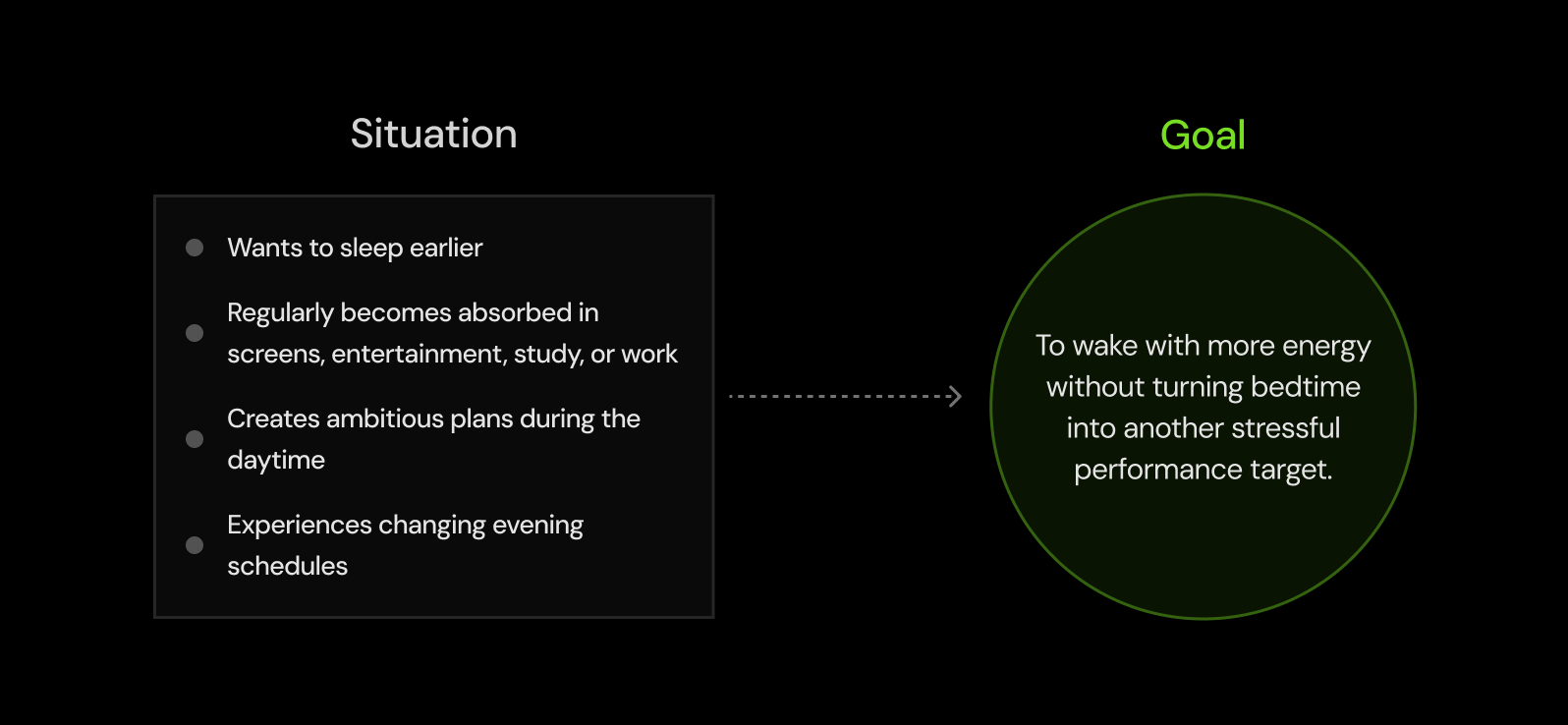
User Context
Primary behavioral segment
The motivated but inconsistent night owl. The primary user is not necessarily unaware of healthy sleep habits. The main difficulty is translating intention into action during an emotionally and cognitively demanding part of the day.
Understanding the User
A. Persona

Name:
Sarah
Age:
27
Hobby:
Biking
Situation:
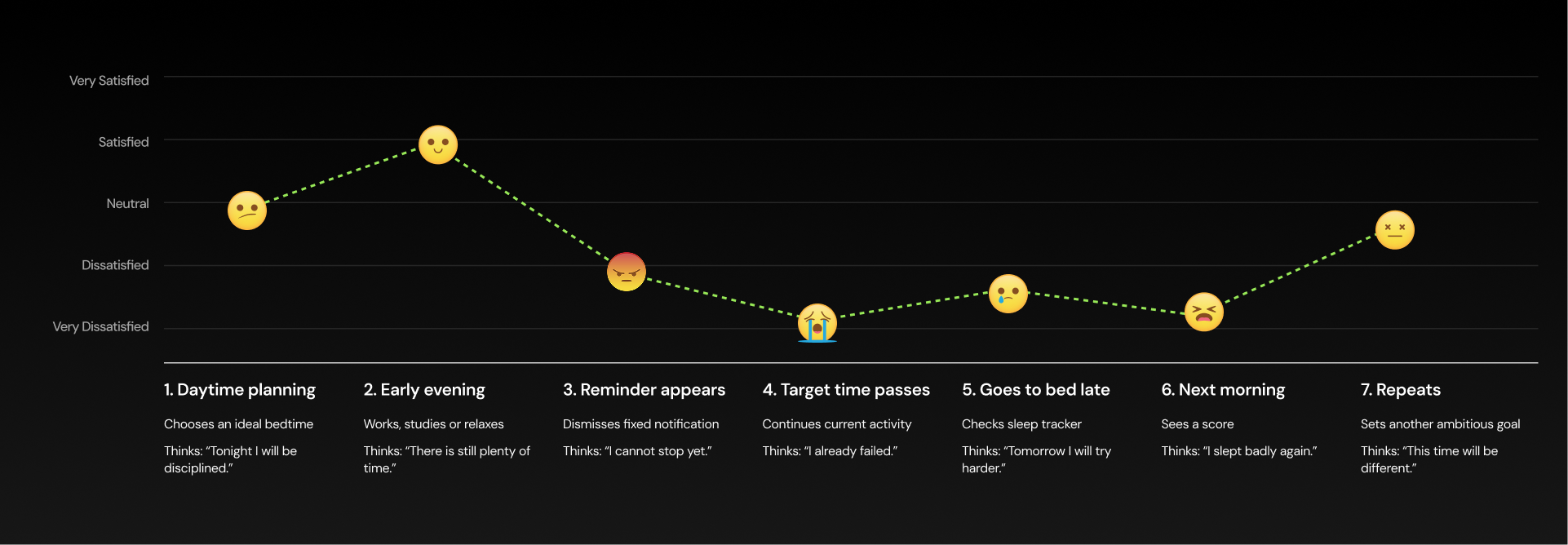
At 9:00 PM, Sarah plans to sleep by 11:00 PM.
She still needs to reply to messages and finish part of a presentation. At 10:15 PM, a standard bedtime reminder appears. She dismisses it because stopping immediately feels unrealistic.
At 11:20 PM, she realizes she is already late. She tells herself that the night is “ruined” and continues scrolling until after midnight.
The next morning, she feels low in energy. Her sleep tracker shows a poor score, but it does not explain how to handle the same evening situation differently. With SleepReset, Maya is not asked to reach 11:00 PM immediately. Her current bedtime is around 12:30 AM, so the first plan targets 12:15 AM.
At 11:35 PM, SleepReset prompts her to begin a three-step routine:
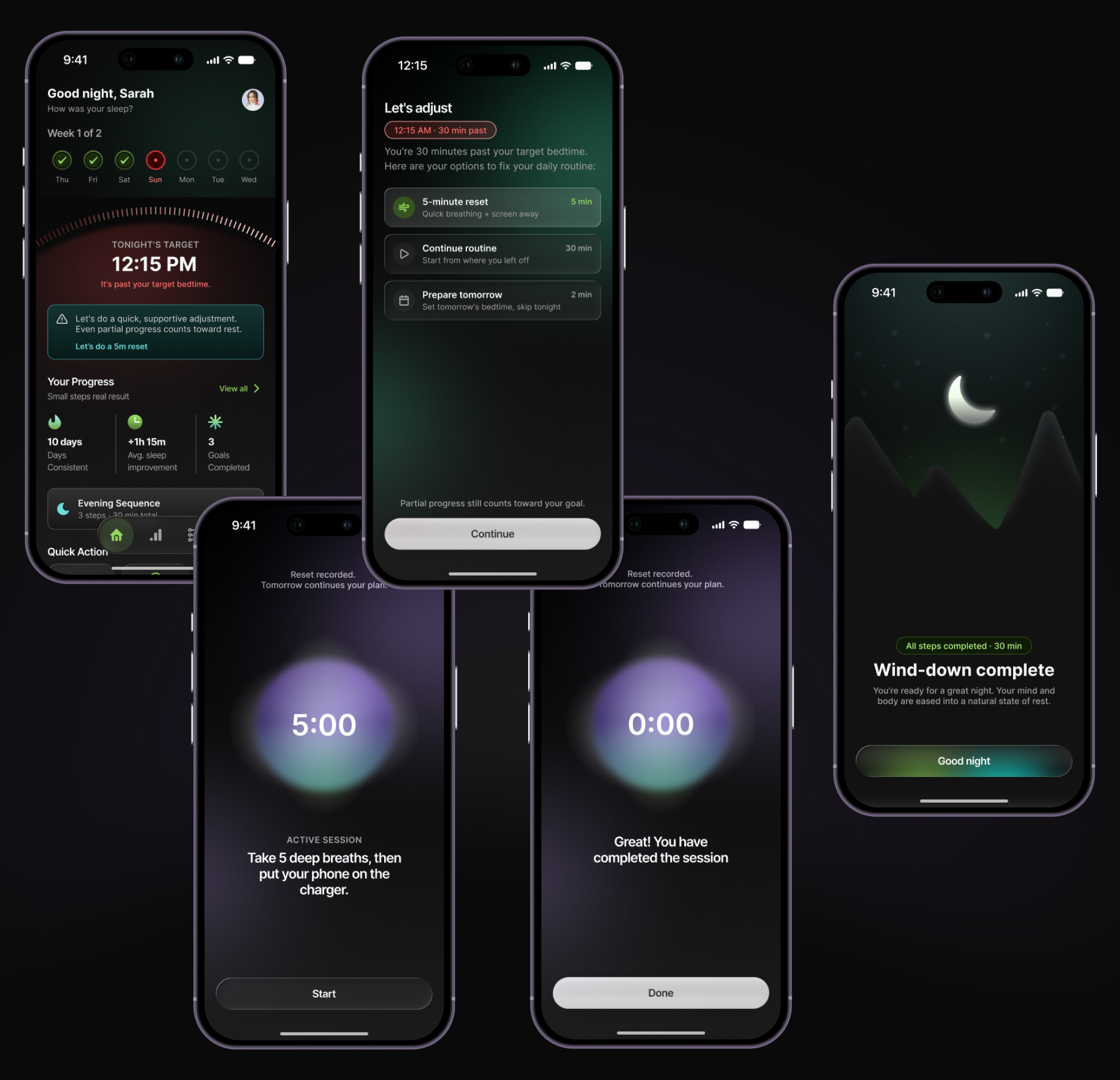
When she reports that work is running late, SleepReset changes the night into a shortened recovery routine instead of marking it as a failure.
The next morning, Sarah rates her energy and reviews one simple reflection. Her plan continues rather than restarting.
B. User Journey
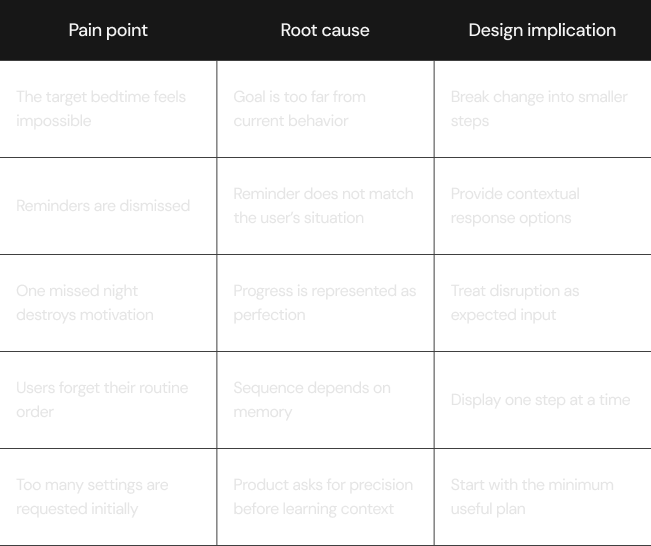
C. Pain-Point Analysis
Problem Statement
Adults with inconsistent evening routines want to reach an earlier bedtime, but rigid targets, competing activities, low nighttime energy, and poor recovery after missed nights make sustained behavior change difficult.
SleepReset has an opportunity to transform an abstract bedtime goal into a gradual, context-aware sequence that supports repetition without requiring perfect adherence.
Product Goals
MVP
Non-MVP
HMW (How Might We)
How might we help people gradually move toward a desired bedtime while protecting their sense of control on imperfect nights?
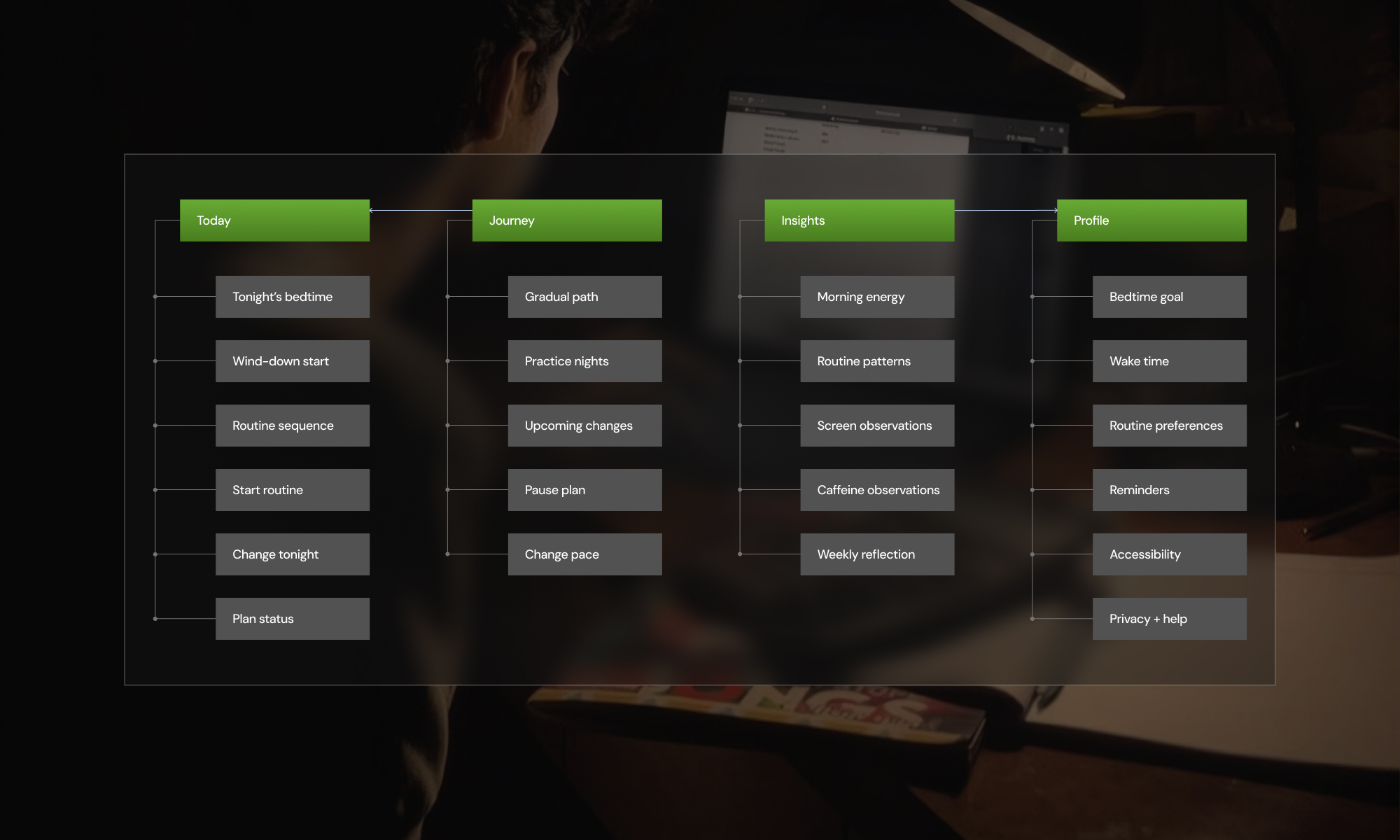
IA (Information Architecture)
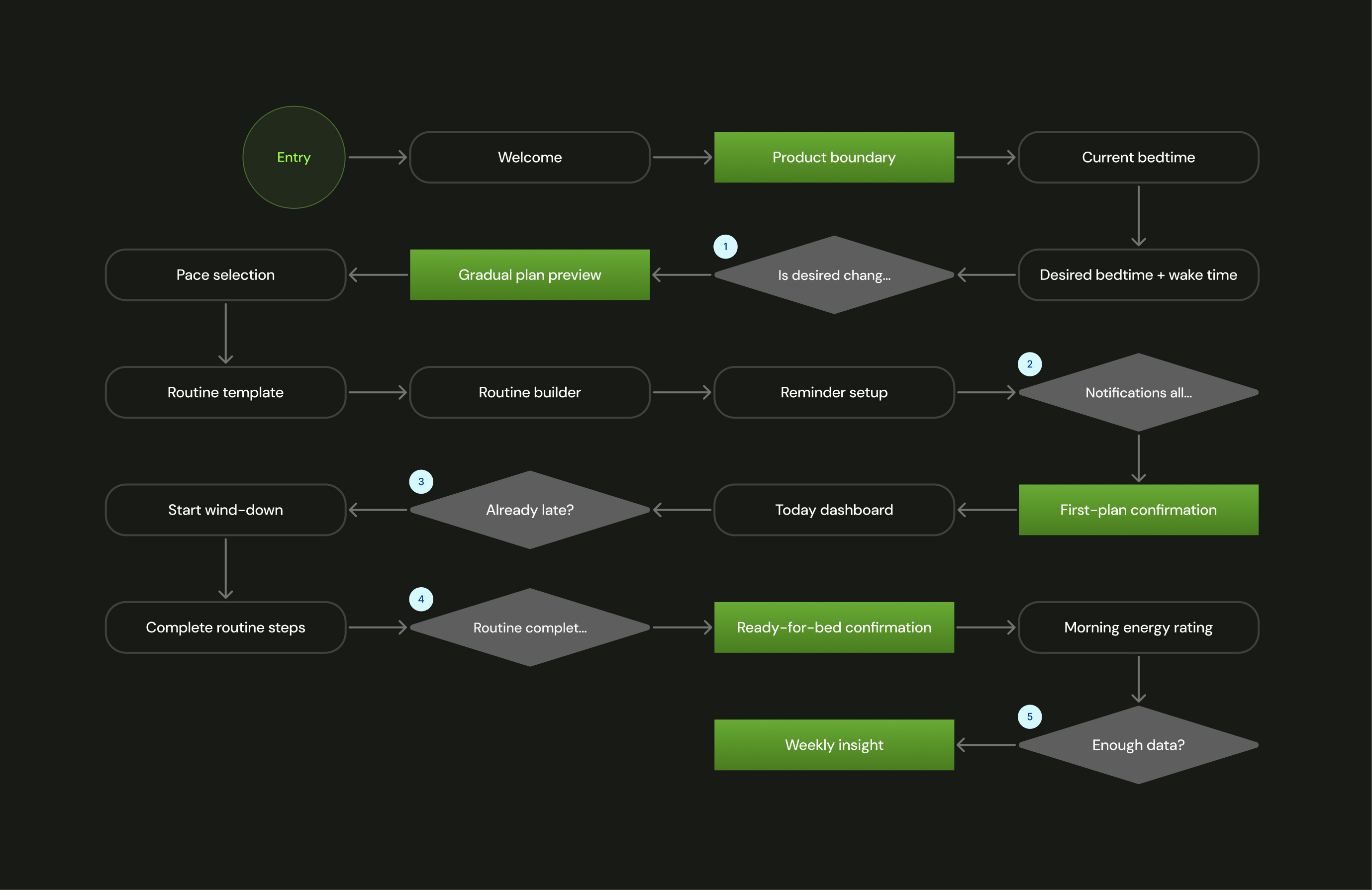
User Flow
Designs
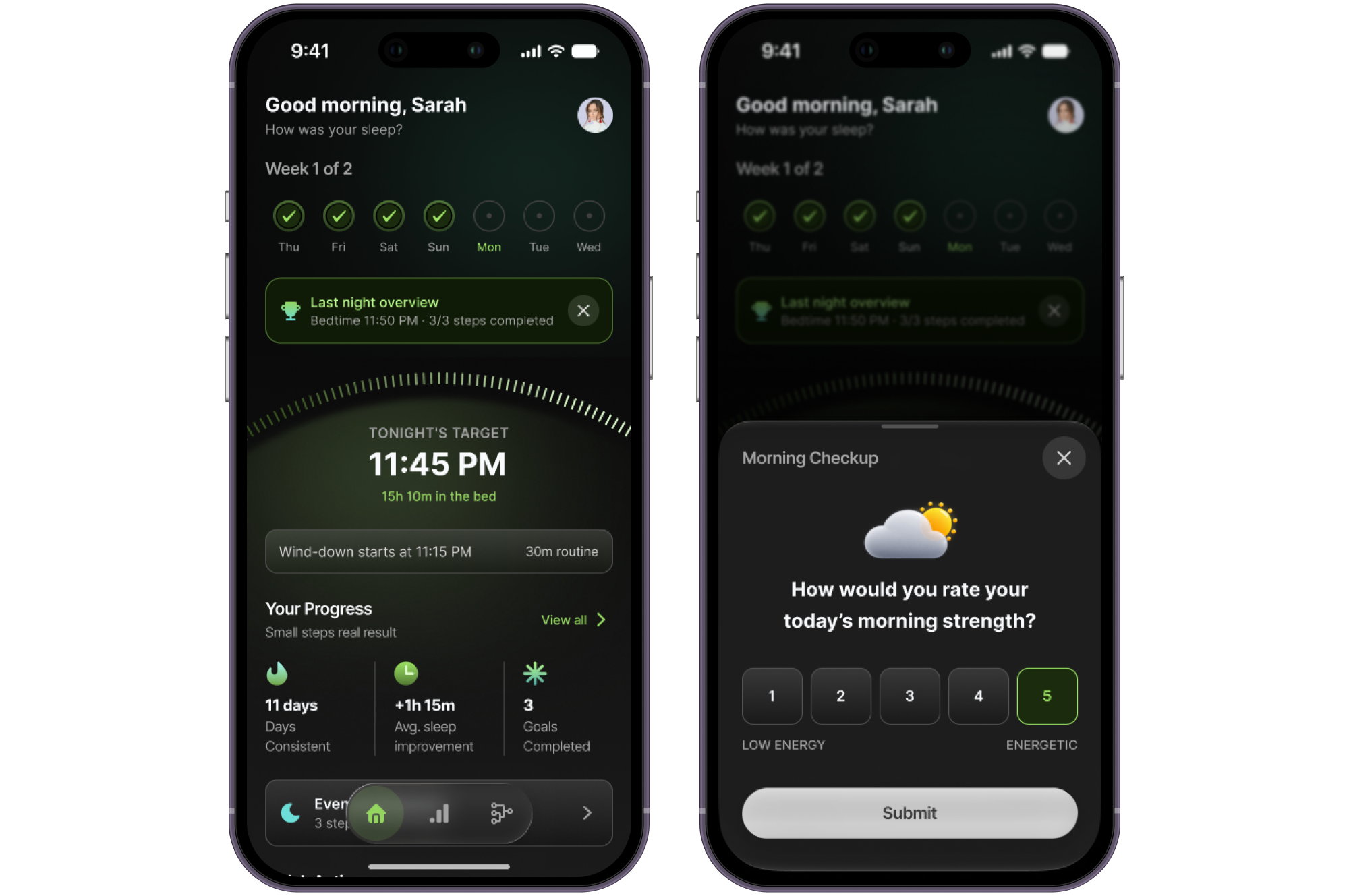
The proposed wireframes turn bedtime into a gentle landing sequence: a realistic gradual plan, a short routine, one step at a time, and a morning energy reflection. The interface keeps tonight’s action clear and makes adjustment and recovery visible.
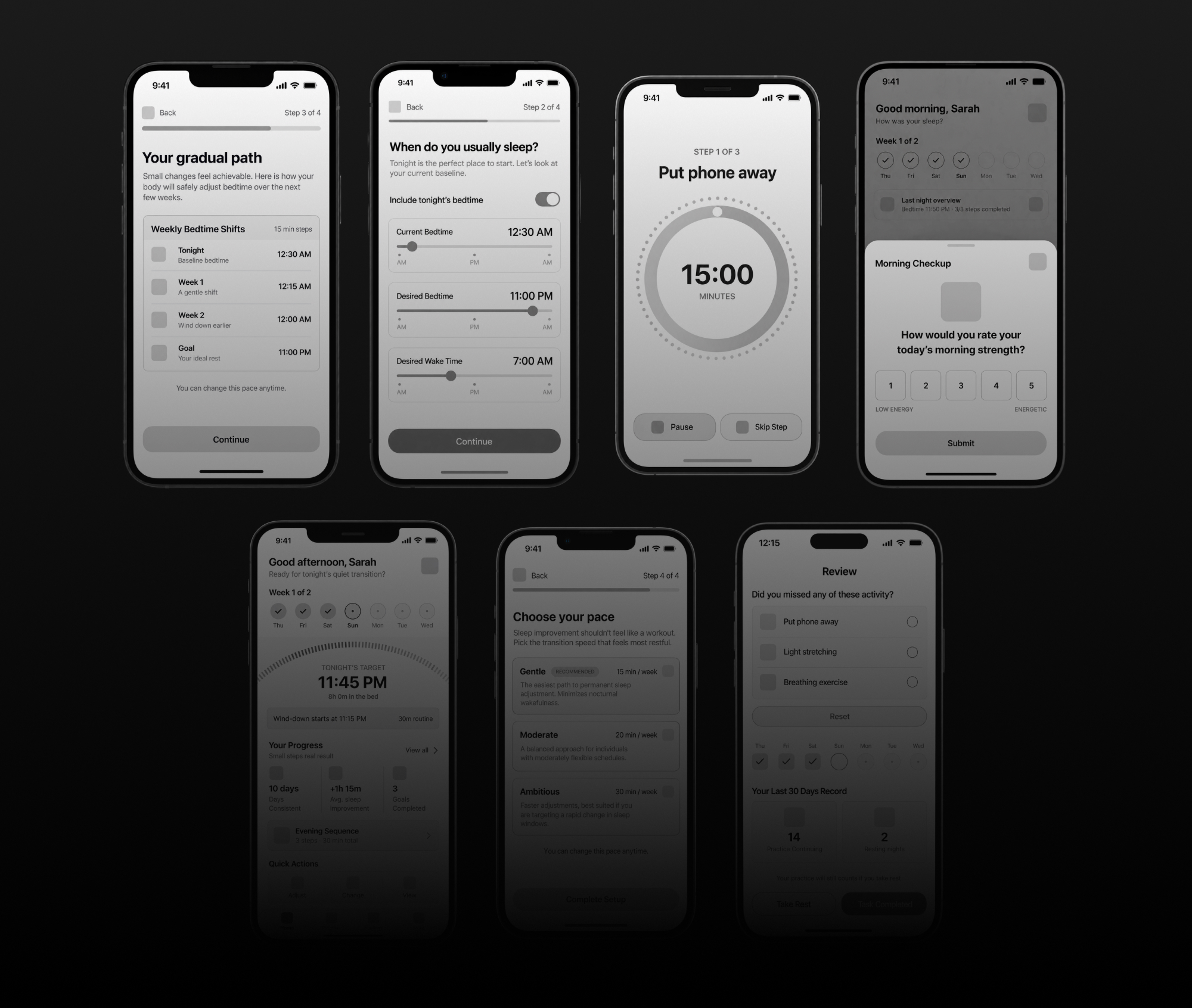
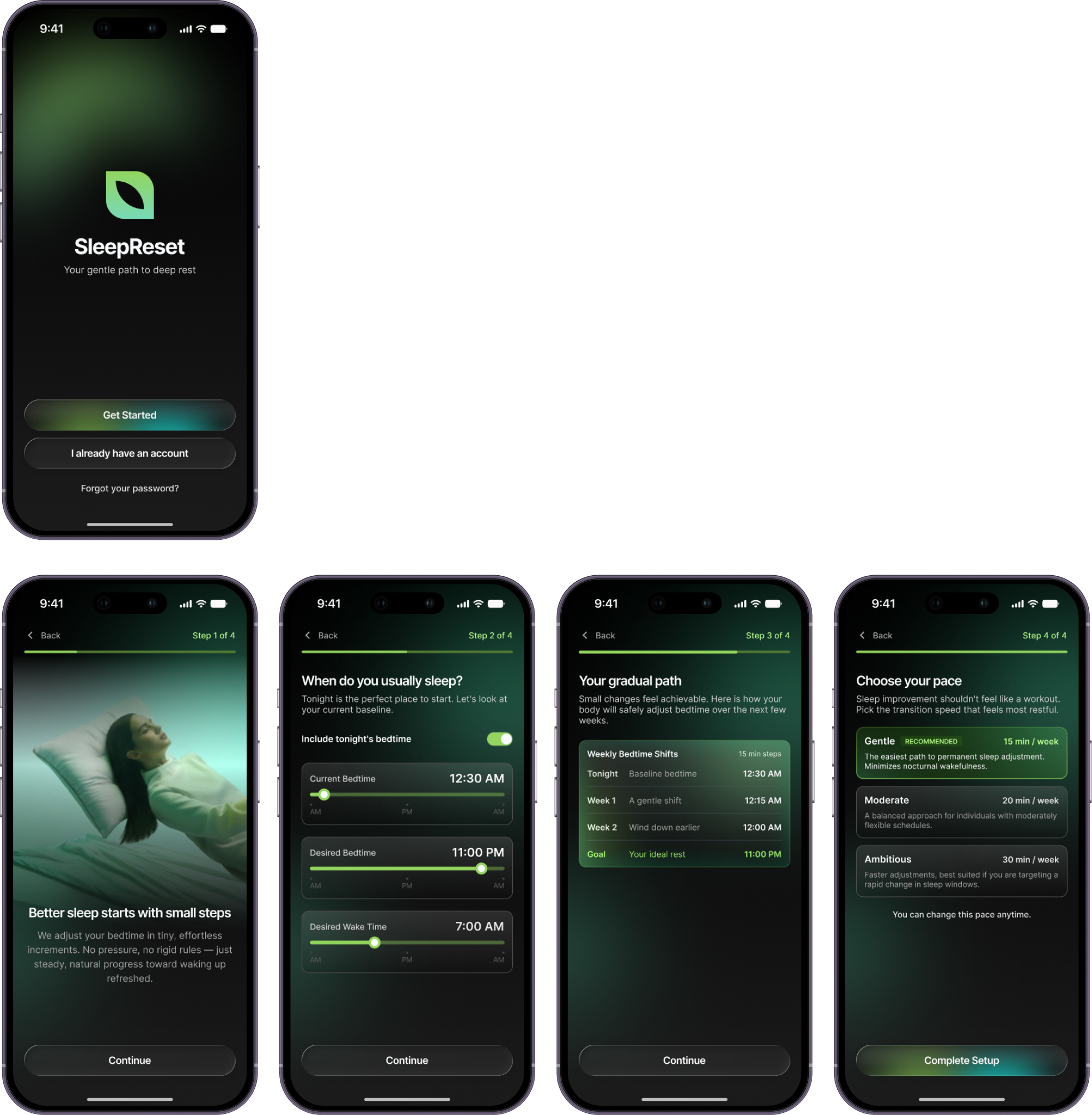
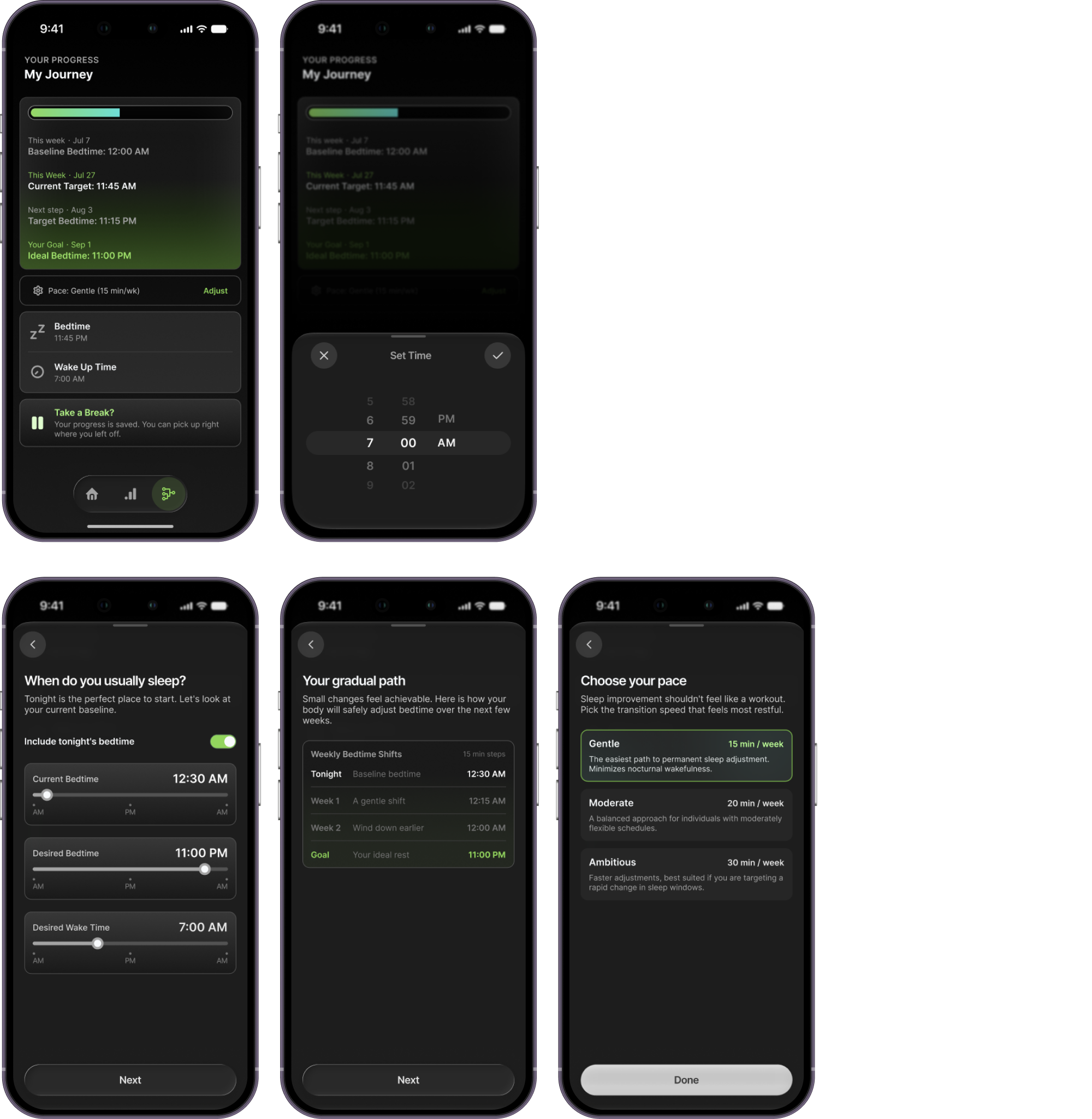
The proposed onboarding begins with the user’s current bedtime, desired bedtime and wake time, then previews a gradual plan. Gentle, balanced and custom pace options keep the user in control; the estimated journey remains adjustable rather than a guarantee.
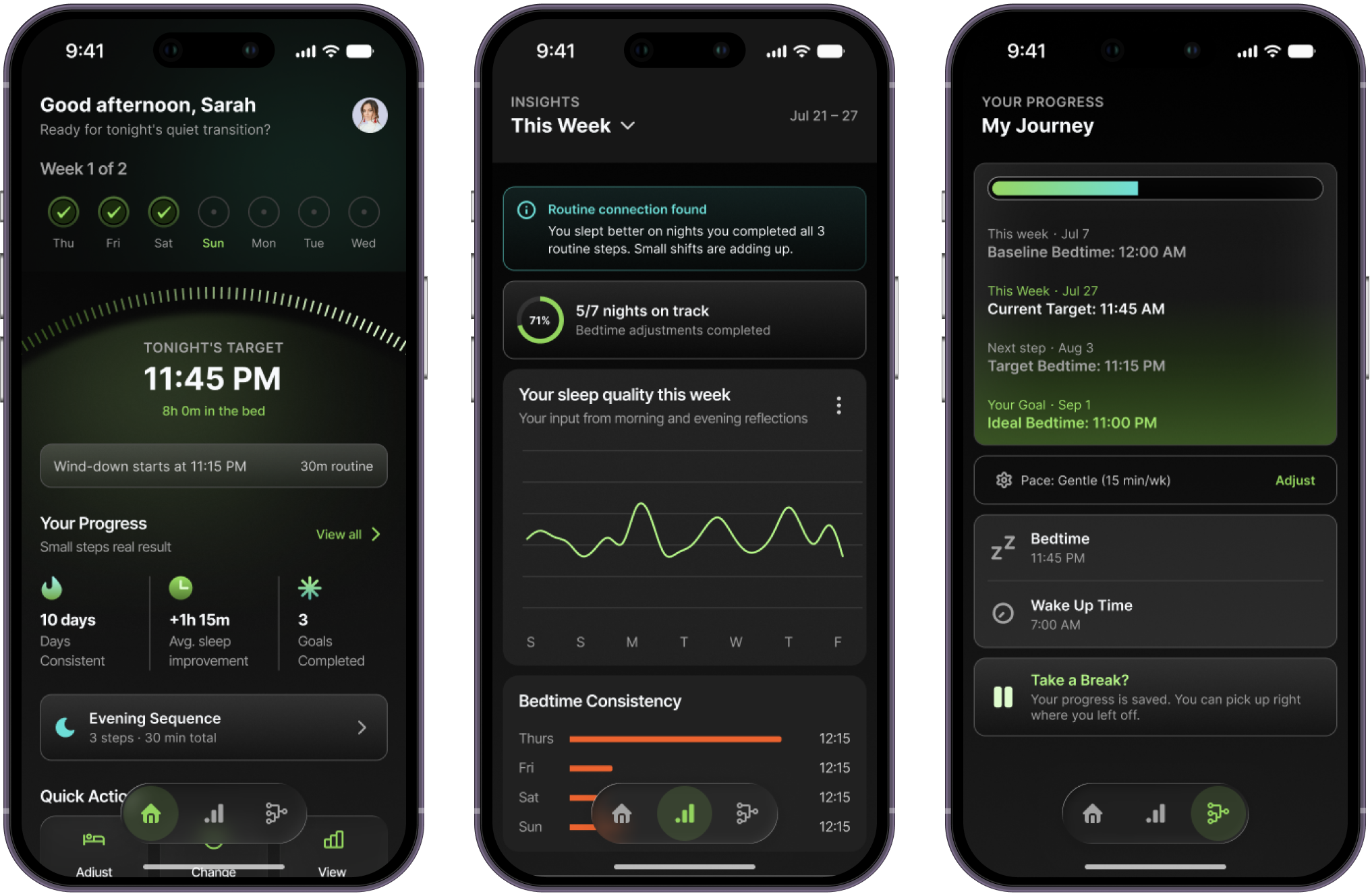
The proposed core experience connects tonight’s wind-down action, the gradual bedtime journey and weekly behavioral insights. Insights should present one observation, its evidence and one suggested experiment; using tentative language rather than unsupported sleep-quality claims.
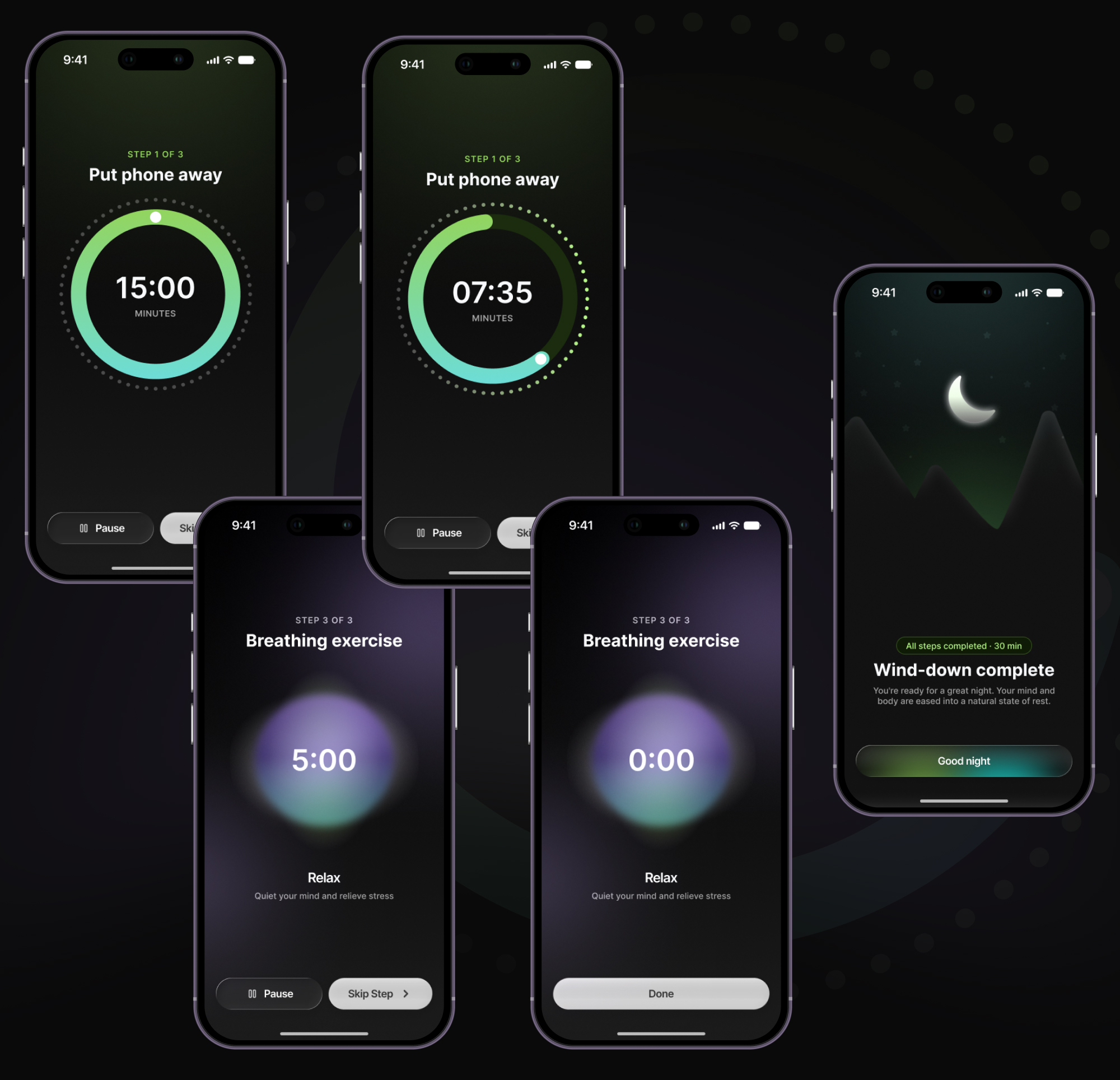
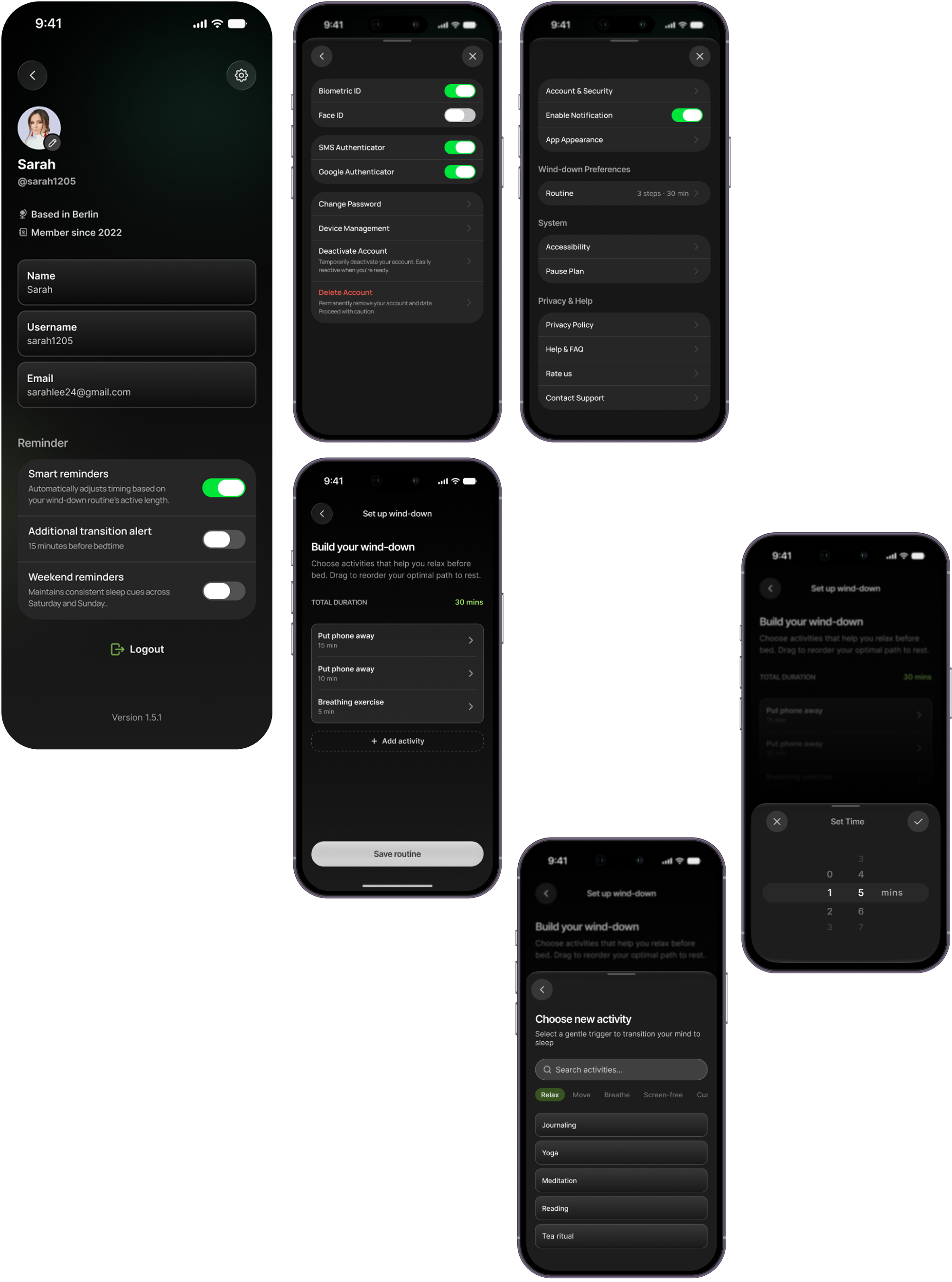
The proposed active routine displays one step at a time, with clear completion, skip and exit controls. Timers are used only when an activity needs them. A calm completion message marks the end of wind-down without promising that the user will fall asleep.
The proposed morning check-in closes the feedback loop with a subjective energy rating. Five clearly labelled states are describe lived experience, not a sleep-quality score or a medical conclusion.
The proposed journey keeps the current bedtime step, desired goal, and adjustment pace visible. To address the risk of a fixed-looking plan, users can edit the goal or pace; any next shift should be explained and presented as a recommendation requiring acceptance.
The proposed settings give users control over bedtime goals, wake time, routine preferences, reminders, accessibility, and privacy. The routine builder starts with three simple steps, shows the total duration and allows the sequence to be reordered and adjusted.
Improved User Journey
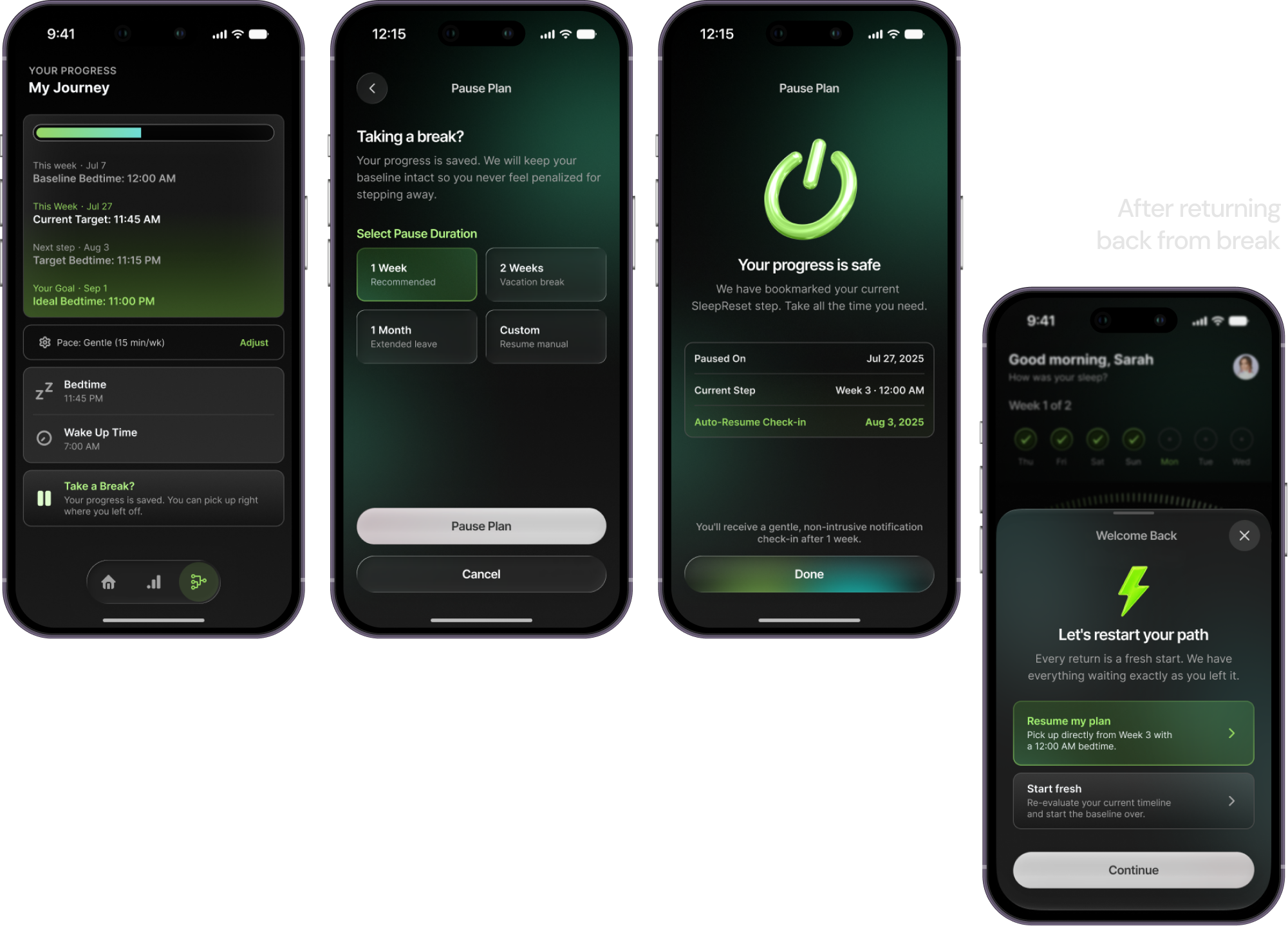
With SleepReset, an abrupt reminder becomes a transition cue and stopping everything becomes one small action. A missed target leads to a recovery version that preserves partial progress; users repeat a manageable step and continue from the current stage rather than restart.
Iteration
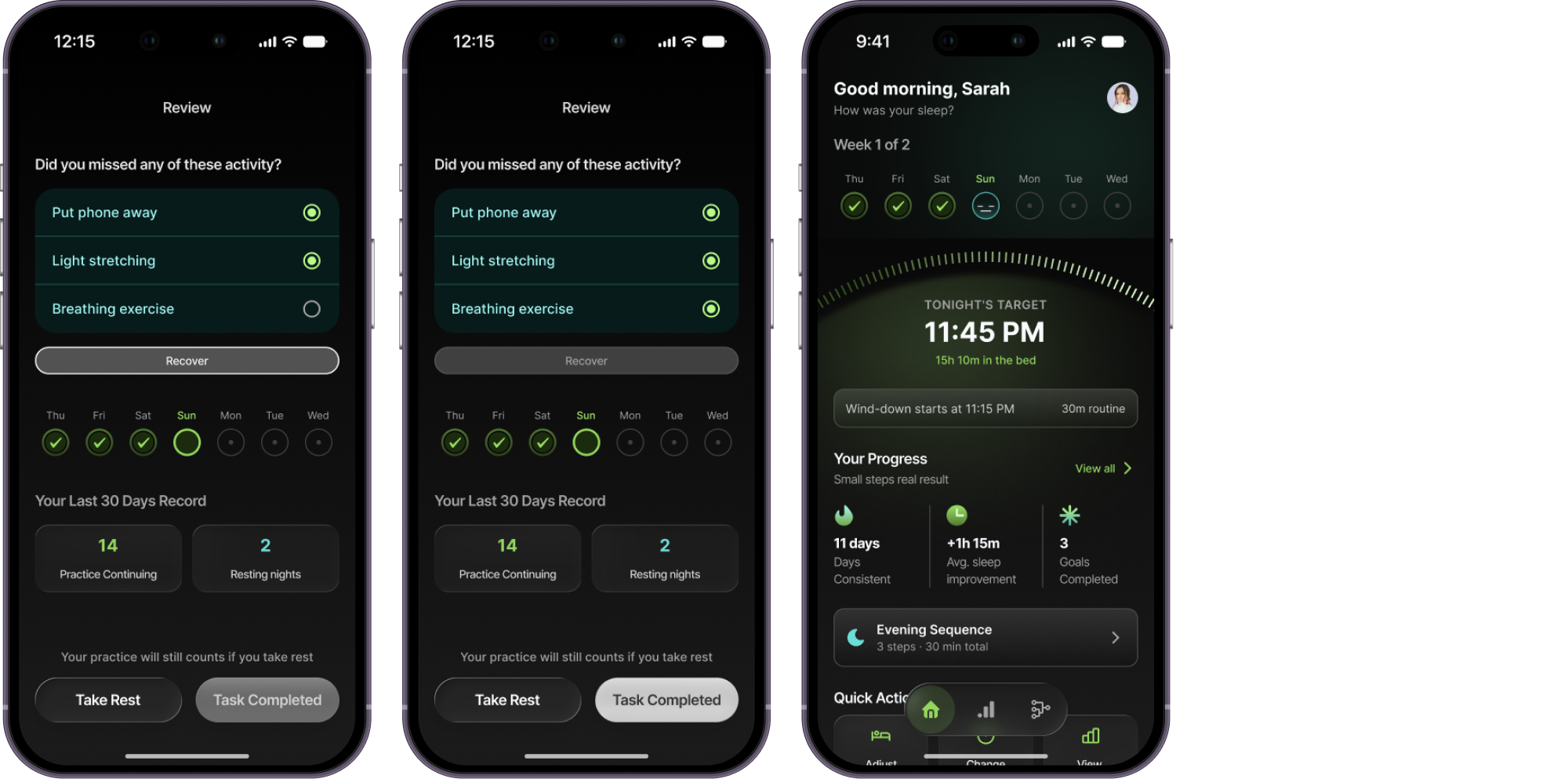
A)
One proposed iteration replaces an uninterrupted streak with “practice nights” and emphasizes resumption. A late start or shortened routine still counts as useful behavior. The aim is to make recovery visible and protect confidence after a disrupted night; this requires validation.
B)
The proposed recovery flow lets users keep the current step, make it smaller, or pause when evenings change. Returning after a break should emphasize continuation rather than failure: “One night does not reset your progress.” Users can resume without losing the overall journey.
Success Metrics
These are proposed measurements, not achieved results. Hypothetical MVP targets:
• User Activation Rate: +15 to 20%
• Weekly Active Users (WAU): +15%
• Support/Intervention Cost: 10% reduction in support dependency
• Customer Lifetime Value (LTV): +10–15% potential LTV growth
Conclusion
SleepReset addresses the gap between knowing that an earlier bedtime would be beneficial and successfully changing the evening behaviors that make it possible.
The deeper problem is not simply poor awareness. It is the combination of unrealistic goals, competing rewards, weak transition cues, reduced nighttime attention, and all-or-nothing feedback.
The design strategy converts a distant bedtime goal into a sequence of small, repeatable, and recoverable actions.
Rather than demanding perfect evenings, SleepReset helps users practice ending the day—one manageable step at a time.

Available for projects
Have a similar
product problem?
Optimize your user experience, resolve product bottlenecks and drive growth.

SleepReset
Product Strategy
UX Research
App Concept
SleepReset is a mobile behavior-change product for people who want to sleep earlier but repeatedly fail to follow rigid bedtime plans.
Instead of only reporting sleep outcomes, the product helps users change the behaviors that happen before sleep: caffeine timing, screen use, unfinished tasks, inconsistent routines, and unrealistic bedtime expectations.

Product
Android, iOS
My role
Design Lead
UX Researcher
Timeline
Q2 2023 - Q2 2024
Product
Product design, Interactive prototyping, User research & testing
Summary
SleepReset focuses on the evening behavior that happens before sleep.
Many sleep products focus on what happened after a user went to bed: duration, interruptions, sleep stages, and scores. These insights may be informative, but they do not necessarily help someone stop scrolling, finish work earlier, or begin winding down consistently.
The user chooses a desired bedtime, builds a short wind-down sequence, and receives a realistic nightly plan. Rather than requiring an immediate jump from the current bedtime to the desired bedtime, SleepReset gradually moves the routine earlier in small steps.
The main UX strategy is:
Reduce the size of the behavior change until completing the routine feels easier than avoiding it.
Project Background
People commonly know that a regular sleep schedule, a calmer pre-sleep period, reduced evening screen exposure, and thoughtful caffeine timing may support healthier sleep habits.
Public health guidance also recommends consistent sleep and wake times, relaxing bedtime routines, limiting electronic devices before sleep, and avoiding caffeine later in the day. [1]

“I still have
work to finish.”

“It is already late, so tonight no longer matters.”

“I missed yesterday, so the plan has failed.”
This creates a gap between sleep knowledge and evening action.
Habit research suggests that small, repeatable actions connected to stable contextual cues can gradually require less conscious effort. Repetition in a consistent context is more useful for habit formation than depending entirely on motivation each night.
Constraints
Research
A. Semi-structured interviews
Participants:
10–12 adults who want an earlier bedtime but struggle to maintain it.
B. Seven-day study
Participant's record:
C. Concept testing
Compare three models:
User Context
Primary behavioral segment
The motivated but inconsistent night owl. The primary user is not necessarily unaware of healthy sleep habits. The main difficulty is translating intention into action during an emotionally and cognitively demanding part of the day.
Understanding the User
A. Persona
Name:
Sarah
Age:
27
Hobby:
Biking
Situation:
At 9:00 PM, Sarah plans to sleep by 11:00 PM.
She still needs to reply to messages and finish part of a presentation. At 10:15 PM, a standard bedtime reminder appears. She dismisses it because stopping immediately feels unrealistic.
At 11:20 PM, she realizes she is already late. She tells herself that the night is “ruined” and continues scrolling until after midnight.
The next morning, she feels low in energy. Her sleep tracker shows a poor score, but it does not explain how to handle the same evening situation differently. With SleepReset, Maya is not asked to reach 11:00 PM immediately. Her current bedtime is around 12:30 AM, so the first plan targets 12:15 AM.
At 11:35 PM, SleepReset prompts her to begin a three-step routine:
When she reports that work is running late, SleepReset changes the night into a shortened recovery routine instead of marking it as a failure.
The next morning, Sarah rates her energy and reviews one simple reflection. Her plan continues rather than restarting.
B. User Journey
C. Pain-Point Analysis
Pain point
Root cause
Design implication
The target bedtime feels impossible
Goal is too far from current behavior
Break change into smaller steps
Reminders are dismissed
Reminder does not match the user’s situation
Provide contextual response options
One missed night destroys motivation
Progress is represented as perfection
Treat disruption as expected input
Users forget their routine order
Sequence depends on memory
Display one step at a time
Too many settings are requested initially
Product asks for precision before learning context
Start with the minimum useful plan
Problem Statement
Adults with inconsistent evening routines want to reach an earlier bedtime, but rigid targets, competing activities, low nighttime energy, and poor recovery after missed nights make sustained behavior change difficult.
SleepReset has an opportunity to transform an abstract bedtime goal into a gradual, context-aware sequence that supports repetition without requiring perfect adherence.
Product Goals
MVP
Non-MVP
HMW (How Might We)
How might we help people gradually move toward a desired bedtime while protecting their sense of control on imperfect nights?
IA (Information Architecture)
User Flow
Designs
The proposed wireframes turn bedtime into a gentle landing sequence: a realistic gradual plan, a short routine, one step at a time, and a morning energy reflection. The interface keeps tonight’s action clear and makes adjustment and recovery visible.
The proposed onboarding begins with the user’s current bedtime, desired bedtime and wake time, then previews a gradual plan. Gentle, balanced and custom pace options keep the user in control; the estimated journey remains adjustable rather than a guarantee.
The proposed core experience connects tonight’s wind-down action, the gradual bedtime journey and weekly behavioral insights. Insights should present one observation, its evidence and one suggested experiment; using tentative language rather than unsupported sleep-quality claims.
The proposed active routine displays one step at a time, with clear completion, skip and exit controls. Timers are used only when an activity needs them. A calm completion message marks the end of wind-down without promising that the user will fall asleep.
The proposed morning check-in closes the feedback loop with a subjective energy rating. Five clearly labelled states are describe lived experience, not a sleep-quality score or a medical conclusion.
The proposed journey keeps the current bedtime step, desired goal, and adjustment pace visible. To address the risk of a fixed-looking plan, users can edit the goal or pace; any next shift should be explained and presented as a recommendation requiring acceptance.
The proposed settings give users control over bedtime goals, wake time, routine preferences, reminders, accessibility, and privacy. The routine builder starts with three simple steps, shows the total duration and allows the sequence to be reordered and adjusted.
Improved User Journey
With SleepReset, an abrupt reminder becomes a transition cue and stopping everything becomes one small action. A missed target leads to a recovery version that preserves partial progress; users repeat a manageable step and continue from the current stage rather than restart.
Iteration
A)
One proposed iteration replaces an uninterrupted streak with “practice nights” and emphasizes resumption. A late start or shortened routine still counts as useful behavior. The aim is to make recovery visible and protect confidence after a disrupted night; this requires validation.
B)
The proposed recovery flow lets users keep the current step, make it smaller, or pause when evenings change. Returning after a break should emphasize continuation rather than failure: “One night does not reset your progress.” Users can resume without losing the overall journey.
Success Metrics
These are proposed measurements, not achieved results. Hypothetical MVP targets:
• User Activation Rate: +15 to 20%
• Weekly Active Users (WAU): +15%
• Support/Intervention Cost: 10% reduction in support dependency
• Customer Lifetime Value (LTV): +10–15% potential LTV growth
Conclusion
SleepReset addresses the gap between knowing that an earlier bedtime would be beneficial and successfully changing the evening behaviors that make it possible.
The deeper problem is not simply poor awareness. It is the combination of unrealistic goals, competing rewards, weak transition cues, reduced nighttime attention, and all-or-nothing feedback.
The design strategy converts a distant bedtime goal into a sequence of small, repeatable, and recoverable actions.
Rather than demanding perfect evenings, SleepReset helps users practice ending the day—one manageable step at a time.
Available for projects
Have a similar
product problem?
Review clinical outcomes, reduce compliance-induced friction and build the right medicine portal today.
@2026 sadmanprodux. All rights reserved.